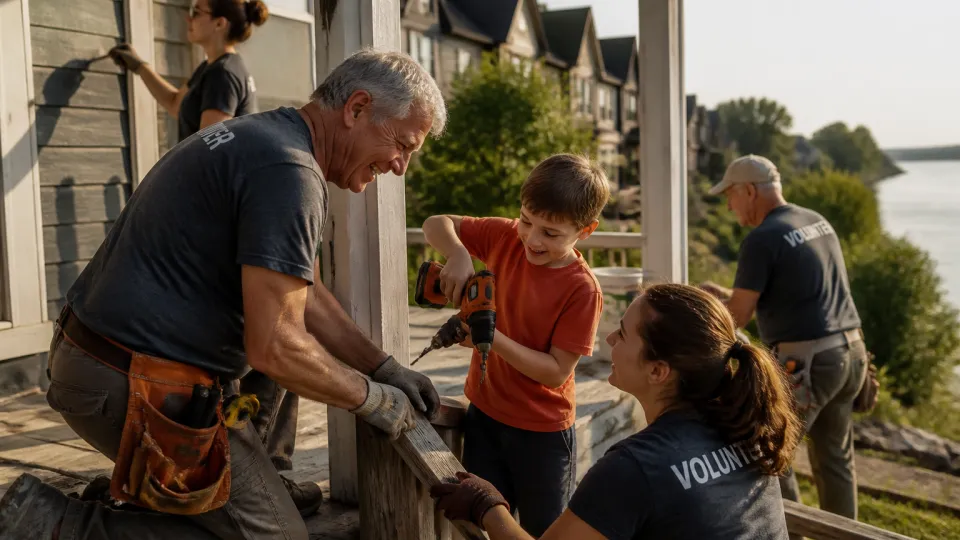
On a cold March morning, eight people carry a stack of insulation into the bungalow on 10th Street. They are a motley crew — a first-year education student from Brandon University balancing a coffee, a retired farmer with weathered hands, a young father with his toddler strapped to his chest, and a woman in her eighties who still lives in the house they are about to weather-proof. They call themselves Hands On Westman, a volunteer cooperative that since 2018 has quietly retooled how service looks in Brandon and the surrounding municipalities.
The scene is vivid because the project prizes two things at once: practical help and human connection. "We didn't want people to feel like a number," says Sarah Nguyen, Hands On Westman's founder and a former social worker. "You show up for an hour to patch a window, but you end up listening to someone tell stories about the neighbourhood for the first time in years." That listening has become as central to the group's impact as the tangible fixes they deliver.
Hands On Westman started as a one-week blitz — volunteers delivering meals and clearing storm debris after a sudden ice storm. The most important lesson was logistical: residents wanted low-barrier ways to give time, and agencies needed flexible, well-coordinated help. In response the group built a schedule of recurring micro-projects: Fix-It Fridays for minor home repairs, Neighbor Tutors matching university students with school-aged kids for an hour a week, and Warm Nights offering winter kits and check-ins for older residents living alone.
The numbers are modest but steady: roughly 600 registered volunteers, more than 10,000 volunteer hours logged last year, and more than 1,200 households served across Brandon and nearby towns such as Neepawa and Virden. These figures matter, but they miss the texture. "My mother wouldn't leave the house for months after her husband died," says Jeanette Miller, 82, who received regular visits from a Hands On Westman volunteer. "At first I thought, I don't need help. Then someone came by to change a lightbulb and we sat and talked. Now I have someone who brings soup and checks my furnace."
The initiative's volunteers are deliberately diverse. High school students pick up service hours by packaging meals; young professionals find single-evening commitments that fit erratic schedules; retired tradespeople lead home-repair teams; Indigenous elders advise on culturally appropriate programming. That mix reduces barriers to participation: family-friendly shifts, clear task descriptions, and a simple online sign-up mean you can volunteer between shifts or bring a child along. "We lowered the friction points," says Emma LeBlanc, the group's volunteer coordinator. "We don't ask for lifelong commitments. We ask for an hour, a skill, a willingness to show up. That has changed everything."
Hands On Westman, though, is not just about plugging volunteers into needs. It has focused deliberately on relationships with institutions. Partnerships with Brandon University and Assiniboine Community College provide background-checked student volunteers and evaluation support; the City of Brandon contributes meeting space and a modest grant; local hardware stores donate materials to Fix-It Fridays. These tie-ins have allowed the group to scale services without losing local independence.
The group's response during last spring's high-water events crystallized its value. When river levees were threatened, volunteers moved sandbags, checked on seniors whose homes sat at lower elevations, and coordinated pet transport. "We weren't the first responders, but we were often the ones who could reach someone quickly because we knew their back lane and their story," says Tom Sutherland, a 68-year-old volunteer and lifelong resident. Those informal networks, he notes, are the difference between a community that endures a crisis and one that gets fragmented by it.
Measurement matters to Hands On Westman. Working with a small research team at Brandon University, they track not only hours served but changes in social isolation scores among seniors, school attendance for tutored children, and the number of repeat requests for repairs. Early results suggest declines in self-reported loneliness and small improvements in attendance among tutored students; municipal leaders point to lower emergency social-service calls in neighbourhoods with concentrated volunteer activity. These metrics have helped the organization secure matching funds and a pilot contract to deliver municipality-supported micro-repairs.
Still, challenges remain. Volunteers burn out; funding is precarious; the organization wrestles with how to sustain momentum beyond crisis periods. Hands On Westman is experimenting with social-enterprise models — training tradespeople through paid apprenticeships while leveraging volunteer labor for lighter tasks — and a new scheduling platform, , aims to make micro-volunteering even easier.
The most convincing measure of impact may be qualitative. In a neighbourhood once punctuated by boarded windows and enervation, families now repaint porches together. Teen volunteers list their service on résumés but talk, when asked, about the conversations they had with elders. "You start to notice faces you didn't notice before," says Nguyen. "You begin to expect that people will show up for each other. That's not quantifiable in the same way as hours, but it's the point."
Hands On Westman is hardly a panacea. It depends on goodwill and civic will that can ebb and flow. Yet the model offers something civic leaders across rural Canada are grappling with: a way to transform volunteerism from episodic charity into a durable civic practice, accessible across ages and incomes. If Westman has a modest claim on the future, it is this: that service, when structured with dignity and convenience, can become a part of ordinary life rather than an extraordinary gesture. For the volunteers on 10th Street, the work ends when the insulation is set and tea is poured. They linger not to be seen, but because someone has finally made space for a conversation that had been postponed for too long.