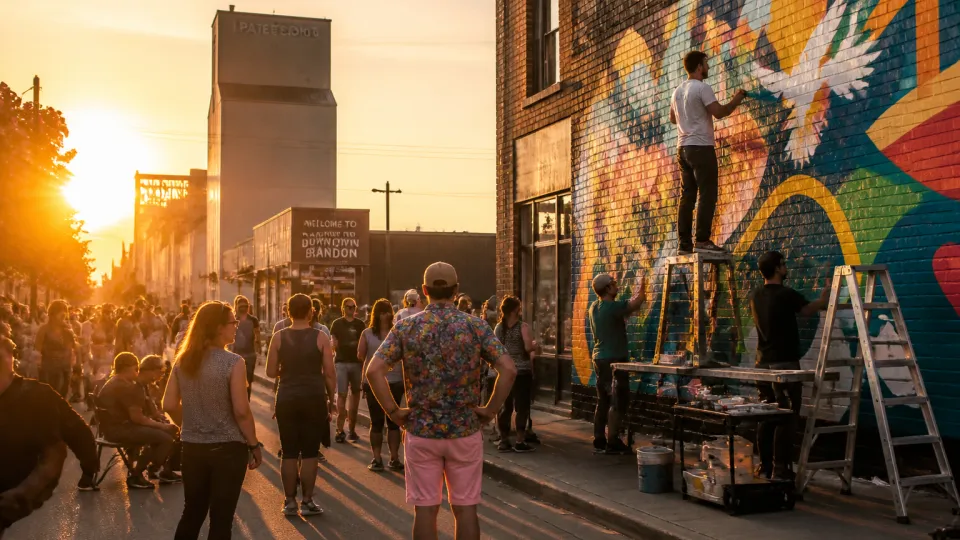
Brandon’s downtown has, in recent years, acquired a different kind of architecture: layers of paint, patched plaster, hand-lettered posters and improvised stages. Walk along 10th Street on a Friday evening and you’re just as likely to find a poetry reading spilling out of a repurposed storefront as you are a ticketed concert. That visible accumulation — of murals, micro-venues and pop-up exhibitions — is the most obvious sign of an invisible recalibration under way in Westman’s cultural ecosystem.
The question this piece follows is not whether art exists in Brandon — it has for generations — but how a mid-sized prairie city is remaking the conditions that support creative work. Across the Westman region, an army of artists, university graduates, civic staff and volunteer boards are trying to answer that question in real time: confronting constrained budgets, shifting demographics and the aftershocks of a pandemic that reoriented audiences and practice alike.
At the centre of many of these experiments is the Art Gallery of Southwestern Manitoba (AGSM). "We had to pivot from being primarily an exhibition space to a community convenor," says Claire Beaumont, a curator at AGSM. "That meant convening artists with neighbours, landlords with youth groups, and funders with people who’d never been inside a gallery before." Those conversations produced a series of low-budget but high-impact initiatives: a residency that paired visual artists with the university’s School of Music, a storefront activation program that rotated exhibitions into vacant commercial spaces, and a public-art policy draft intended to leverage private walls for community stories.
Those stories are often Indigenous. Brandon sits within Treaty 2 territory and is home to Métis communities whose cultural resurgence is increasing the visibility of Indigenous arts across the region. One example is an intergenerational beadwork project that traveled through smaller towns in Westman, bringing together youth and elders to make ceremonial items, while documenting local histories. "For many participants, it’s a way of reclaiming time," an organizer told me. "It’s art and it’s care, and both are necessary for a healthy public life."
Yet those initiatives exist against stubborn structural headwinds. Provincial and municipal budget pressures have tightened predictable support, and many artists report precarious incomes. A recent survey by a local collective found that nearly two-thirds of working artists in the region relied on secondary employment to make ends meet. That economic squeeze accelerates an old pattern: the most ambitious makers leave for larger centres. But it also produces countervailing trends.
Affordability and quality of life have become unexpected magnets. Young creatives drawn by lower rents and a visible post-pandemic desire to work outside of larger centres have started to experiment in Brandon — creating co-working studios, launching DIY festivals and converting underused spaces into rehearsal rooms. The result is a diffuse network of places where art gets made, not a single destination. "We don’t have the luxury of one cultural quarter," says Matteo Lopez, a theatre-maker who co-runs a tiny black-box company in a former machine shop. "That pushes us to collaborate across discipline, to activate unlikely spaces — and it makes audiences curious in a different way."
Collaboration with Brandon University is another bulwark. Its School of Music and visual arts programs supply talent, and an increasing number of faculty-led community projects blur the boundary between campus and city. Students stay for internships with non-profits; faculty curate neighborhood workshops; graduates, sometimes, decide to stay and build micro-enterprises. The university’s role in skill development, combined with municipal interest in cultural tourism, frames a practical argument: supporting arts is not merely aesthetic, it is economic infrastructure.
This convergence is producing heated civic choices. Should the city invest in a single large cultural hub, or seed many small, dispersed projects? How should public art reflect settler and Indigenous histories without flattening either? These questions have created friction — public consultations, disputes over mural content, debates about grant criteria — but they have also spurred a clearer conversation about who benefits from cultural investment.
The human story here is pragmatic and stubborn. In Virden and Neepawa, volunteers rebuild theatre lobbies. In Brandon, a barista runs an improvised exhibition space; in Dauphin, a community choir revived after the pandemic is now training young leaders. These are small acts of civic repair that, collectively, add up. They show a cultural life that is not a fixed amenity but a set of practices — making, sharing, arguing, repairing.
Looking forward, will depend on blending flexible funding with long-term commitments. Smaller grants that enable experimentation must be paired with stable operating support for institutions that anchor networks. Policy-makers can start by recognizing the economic spillovers: downtowns that host artists enjoy increased foot traffic and diversified services, while collaborative projects reduce social isolation and nurture youth engagement.
Brandon’s quiet renaissance will not arrive as a single silver-bullet announcement. It’s emerging through accumulative, often messy work: a painted wall here, a shared rehearsal space there, a student who decides to stay. The real test will be whether civic leaders and funders can move from episodic rescue to steady care — keeping alive the conditions that allow art and community to sustain one another.
For now, the city’s cultural life is proof of another truth: in the prairie's flat light, small acts of artistry become luminous. They map out who we are and, more importantly, who we might yet become.