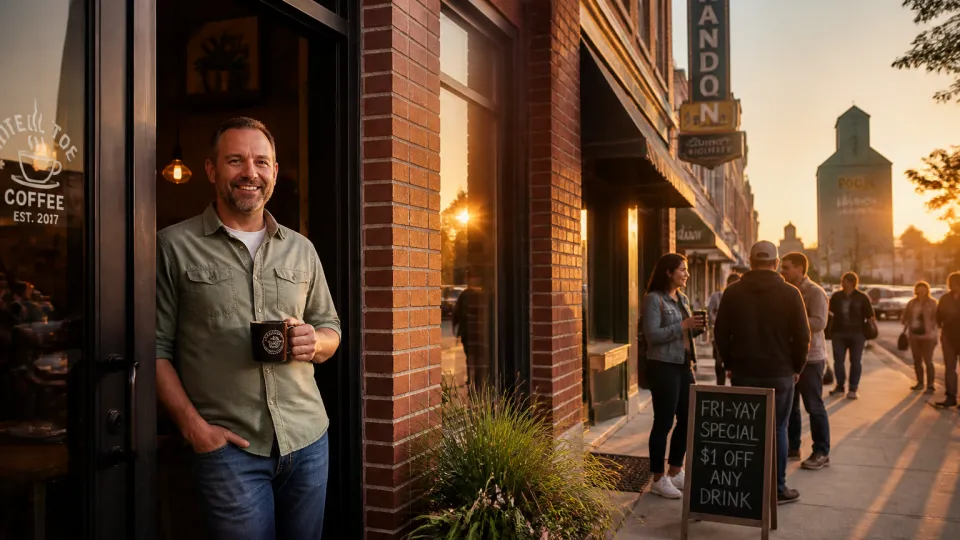
On a gray Thursday in late April, the light that slips between the eaves of a renovated brick storefront on Brandon's Rosser Avenue smells faintly of coffee and sawdust. Inside, Liam Peters tends an industrial roaster whose temperature gauge looks as if it were built for a lab. He gestures toward a chalkboard menu and the queue of neighbors: "We didn't set out to save Main Street," he says, smiling, "but it turns out starting a business is the most public kind of neighborly work."
That observation—about business as civic service—recurs across Westman, where is less an isolated pursuit of profit than a deliberate answer to problems caused by demographic decline, service gaps, and shuttered storefronts. In towns that lost grocery aisles and bank branches over a generation, new ventures are knitting back pieces of daily life and, in the process, reimagining what rural prosperity can mean.
Take Neepawa, where Harriet Fournier converted a portion of her family farm into a cut-flower CSA and workshop space. "People come for flowers and stay for the conversation," she says. What began as a pragmatic pivot—finding a buyer for imperfect stems during a volatile season—has turned into an afternoon ritual for retirees, new parents, and seasonal workers. Fournier's biweekly workshops teach floral arranging, but they also revive social rituals: shared labor, seasonal calendars, and the passing down of local knowledge. For a community negotiating loss and change, those rituals are a form of structural repair.
In Rivers, a small but growing collective of young entrepreneurs has clustered around precision agriculture and software services. Maya Singh, who grew up north of Brandon and returned after university, co-founded PrairieSense, a startup that pairs low-cost soil sensors with a farmer-first data platform. "We weren't trying to out-tech the Prairies," Singh explains. "We wanted tools that fit the rhythm of small farms—affordable, understandable, and built with farmers, not for them." What began in a basement co-working space has become an on-farm testing program that employs seasonal tech support and keeps hardware repair local.
These individual stories add up. They signal a shift from an older economic model—one dominated by a single large employer or the extraction of resource value—to a mosaic economy of micro-enterprises, cooperatives, and hybrid nonprofits. The impact is both economic and social: new jobs and taxable activity, yes, but also restored access to services, improved mental health through purposeful work, and renewed civic life.
Consider the way entrepreneurship alters daily geographies. A bakery in Virden that sources grain from nearby farms becomes a de facto aggregation point for producers and bakers; an artisan brewery in Brandon partners with a culinary program at Assiniboine Community College to create an apprenticeship pipeline. These are not isolated transactions but flows of knowledge, people, and trust. "Our apprenticeships are about more than skills," says a program coordinator. "They're an invitation to belong." That belonging matters in places where young people are often forced to choose between migration and staying without prospects.
Challenges remain. Broadband gaps, access to capital, and a shortage of affordable commercial real estate are real constraints. Many rural entrepreneurs rely on braided survival strategies—government grants, part-time jobs, volunteer labor, family equity—that make growth precarious. But in conversations with municipal leaders and local lenders, a consistent theme emerges: small wins become bigger when systems change.
This is where regional collaboration becomes decisive. A shared incubator model in Westman—pooling mentorship, equipment, and marketing resources across towns—has started to show results. When a mobile packaging line purchased cooperatively rotates between towns, participating producers enable markets that none could reach alone. Strategic investments in digital infrastructure and a modest expansion of business-advisory services could magnify these effects.
The future of entrepreneurship in Westman is therefore less a tale of lone inventors than of infrastructure and relationships: affordable, distributed tools; training that stays local; and financing that understands uneven seasonal income. It is also generational work. "My worry isn't whether we'll have startups," says an elder farmer in Rivers who now mentors a young ag-tech founder. "It's whether we're building something my grandchildren can be part of."
There is an unmistakable poetry to the projects taking root here: creative economies that honor place, and practical enterprises that revive social bonds. In Westman, entrepreneurship is an answer to scarcity—but it's also a method for making community. That blend of grit and care may ultimately be the region's most important export.
As Liam closes the roaster for the day, the light has gone pink behind the grain elevators. Customers linger, talk turns to a local fund supporting storefront renovations, and a teenager sketches logos at a corner table. The future, in these hours, looks like accumulated small acts—risk taken with neighbors watching—and like a promise: that the work of building a resilient community can be done one honest business at a time.