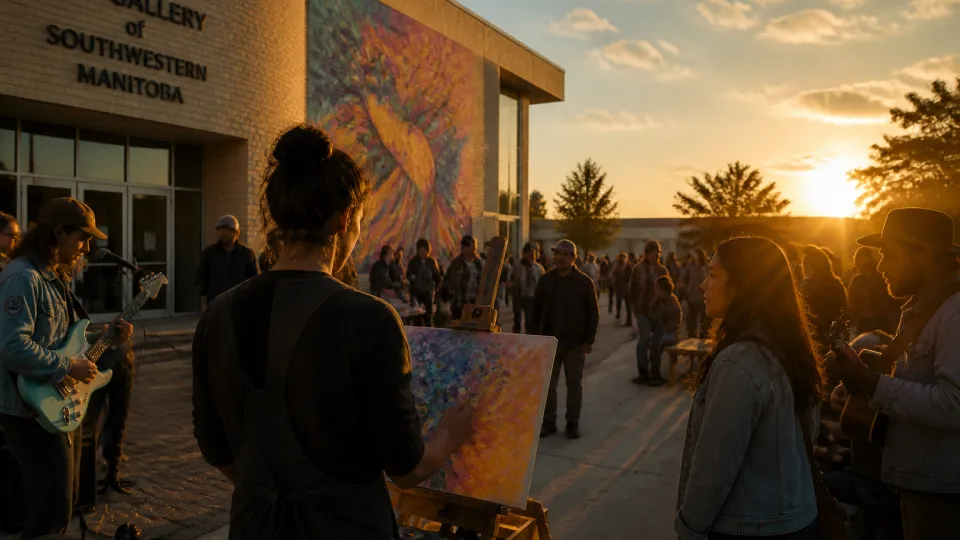
On a late summer evening, the low angle of prairie light gilds the brick face of the Art Gallery of Southwestern Manitoba. Musicians tune on the sidewalk; a muralist touches up a figurative scene of a river and train tracks; children chase each other around a temporary sculpture of welded metal fashioned from recycled farm machinery. It is an ordinary, unembellished scene, and yet it contains the accumulated history of a region that has learned to make culture out of scarcity and civic will.
The story of Westman’s is, fundamentally, a social history. It is about volunteer committees that stayed up late to plan festivals; teachers at the Brandon University School of Music who expanded the reach of conservatory training into community classrooms; elders who insisted that Indigenous story and art be central, not peripheral, to celebrations; and storefront galleries that opened because someone scraped together rent for a month and a stack of borrowed chairs.
After the upheavals of the mid-20th century — shifting agricultural economies, urbanization, and the slow attrition of local services — Brandon and its surrounding towns were left with choices. For many, culture became a form of stubborn renewal. Small institutions, from community theatres to the gallery on Princess Avenue, acted as scaffolding. They provided rehearsal rooms, exhibition walls, and meeting spaces where public life could be rehearsed and remade.
The Art Gallery of Southwestern Manitoba, for example, long ago stopped being just a place to hang paintings. It is a crucible where rural narratives and contemporary practice meet: exhibitions have paired prairie landscape painters with multimedia Indigenous artists; school programs bring students to see the work of photographers who document local labour and migration. Across town, the Western Manitoba Centennial Auditorium has functioned as both a stage for visiting companies and a training ground for local theatre-makers. The rhythms of rehearsal and production have bound together multiple generations.
Equally important have been the large and small festivals that stitch the region together. The decades-old folk gatherings and chamber music weekends are not merely entertainment; they are economic stabilizers and points of civic identity. They provide seasonal work for technicians and vendors, reasons for alumni to return, and a calendar around which volunteerism coalesces.
But the human story is what gives these institutions momentum. I spent an afternoon with a retired schoolteacher who now volunteers at a youth arts collective. She described a teenager who arrived at a summer pottery class “with a chip on his shoulder and nothing to say.” Months later, he was teaching younger kids and had found a part-time job at a ceramics co-op. "We didn't just teach him how to make a bowl," she said. "We gave him the habit of finishing something, and from that he began finishing other things in his life."
Indigenous artists and storytellers have, in recent years, reclaimed centrality in Westman cultural life. Through partnerships — sometimes productive, sometimes messy — museums and galleries have begun to reorient exhibitions and educational programs to foreground Indigenous perspectives, languages, and protocols. This shift is neither symbolic nor simple; it has required labor, humility, and institutional change. The result, however, is a richer public life in which place-based knowledge is visible and celebrated.
Economic realities remain stubborn. Funding cycles are short; municipal budgets are tight; and the costs of touring, touring, materials, and venue upkeep rise. Yet creative responses continue. Artists adopt hybrid practices, combining online platforms with community workshops; co-ops and shared studios reduce overhead; and younger curators experiment with pop-up shows and cross-disciplinary residencies that travel between Brandon and smaller centres like Minnedosa and Neepawa.
The long view shows that arts investment is not merely discretionary spending. It anchors downtown revitalization, supports hospitality and retail sectors, and — critically — keeps young people tethered to the region. When a composer from Brandon premieres a chamber work inspired by the Souris River, or a graduating visual artist mounts an installation on 10th Street, they create signals that the region is interesting and alive.
Looking forward, Westman’s cultural sector faces an opportunity to consolidate gains into durable structures. That means sustained municipal and provincial support, yes, but also the patient accumulation of capacity: endowments, apprenticeship pathways in technical production, and stronger partnerships with Indigenous communities and educational institutions. It means treating arts infrastructure as part of civic infrastructure, not as optional ornament.
There is, finally, an ethical dimension to this work. Preserving the past is not about fossilizing it; it is about allowing histories to inform inventive futures. The prairie has always been a place of movement — of crops, people, ideas — and its cultural life thrives when it allows displacement and belonging to coexist. In Brandon, the murals, the festivals, the rehearsal rooms, and the quiet mentorship that happens over coffee are all expressions of a public imagination determined to endure.
I left the gallery as dusk deepened, noticing a small crowd lingering, reluctant to disperse. They were not waiting for spectacle. They were, quietly and collectively, performing the most unglamorous work of democracy: showing up, listening, making, and keeping a place to belong.
That steady practice, more than any marquee headline, may be Westman’s most enduring cultural contribution.