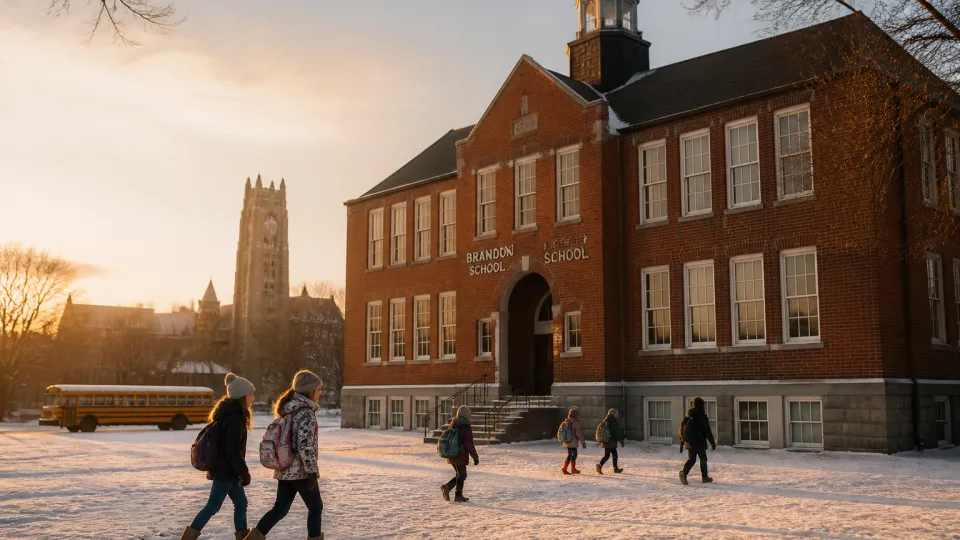
In the fall light of Westman, school buildings read like a map of change. Weathered clapboard one-room schools stand in memory and photograph; modern brick institutions—Brandon University and Assiniboine Community College among them—anchor downtown skylines and civic calendars. That contrast is not simply architectural. It traces how learning in Brandon and the surrounding plains moved from survival and literacy toward vocation, civic belonging, and, more recently, questions of reconciliation and digital inclusion.
The earliest schoolhouses were pragmatic answers to isolation. Settlers cut classes to the rhythm of harvests and winters; a single stove heated a handful of grades. Those rooms taught more than letters. They taught community norms, civic rites—Christmas concerts, Remembrance Day—and the expectation that a school was a public place where people debated, married, and mourned. For many farm families, the teacher was the town's most visible professional: often young, sometimes transient, always central to rural social life.
Through the mid-20th century, consolidation remade that landscape. Smaller schools closed or combined into larger divisions; buses lengthened the school day but broadened course offerings. Brandon itself evolved from a service town to an educational hub. Local institutions expanded curricula to meet a changing economy: trades and applied programs for mechanization on the farm, health and human services for a growing regional population, and liberal arts that kept the conversation about identity and history alive.
That institutional growth carried human stories. A woman I spoke with—who grew up in a rural school west of Brandon—remembered the disciplinary authority of one teacher whose expectations opened a path to university. Another former student recalls night classes in a community college welding shop, where the instructor's patience meant a stable income and a new life trajectory. These micro-narratives underscore how schooling in Westman has always been both pragmatic and aspirational.
Yet the arc of educational progress has not been linear or untroubled. Indigenous students in the region experienced schooling through policies that sought assimilation and silence. Those legacies persist in family histories and in the current work of schools and post-secondary institutions seeking to respond meaningfully to the Truth and Reconciliation Commission's calls. In Brandon today, that work is visible in curriculum changes, elder involvement on campus, and partnerships with local First Nations and Métis communities that emphasize language revitalization and land-based learning.
The last decade introduced another set of accelerants: economic shifts, demographic changes, and . Brandon welcomes newcomers—international students and immigrant families—who arrive with educational needs that stretch beyond language, into credential recognition and adult upgrading. Meanwhile, employers in agriculture, manufacturing, and healthcare ask colleges and universities to produce technicians fluent in robotics, clinical practices, and data analytics.
COVID-19 exposed both fragility and creativity in Westman's learning ecosystem. Remote instruction highlighted the digital divide: for some rural households, a buffering video was a minor annoyance; for others, a lack of reliable broadband severed access entirely. Yet the crisis also spurred innovations that stuck. Hybrid course models, community learning hubs where students can access computers and mentorship, and closer alignment between employers and educators have become part of the new normal.
At street level, the real impact is felt in the modest, steady work that ties schools to social life. A downtown elementary that hosts a food bank distribution, a community college storefront offering high-school equivalency classes in the evenings, a university lecture series that brings elders to the stage—these are the places where education functions as public service and civic glue. Teachers, custodians, counsellors, and librarians are the everyday fixers whose labor transforms institutional promises into lived reality.
Looking forward, the central question for Westman's education is less whether institutions endure and more how they orient themselves to the region's complex needs. That means investing in broadband and transportation so rural students can access the same opportunities as urban peers. It means sustained partnerships between post-secondary institutions and local industries so that training matches job markets while preserving the curiosity-driven work of the liberal arts. And crucially, it means centring Indigenous perspectives not as an add-on but as a structural element of curricula and campus governance.
Education in Westman has always been adaptive—shaped by weather, economics, and migration. Its future will be defined by the degree to which local institutions listen: to elders, to employers, and to students whose lives straddle farms, small towns, and city streets. If the past century taught one lesson, it is this: schools succeed when they belong to a community, and when a town's hopes are folded into classroom practice. The next chapter of learning in Brandon and its hinterland will depend on nurturing those belonging ties while equipping learners for a rapidly changing world.