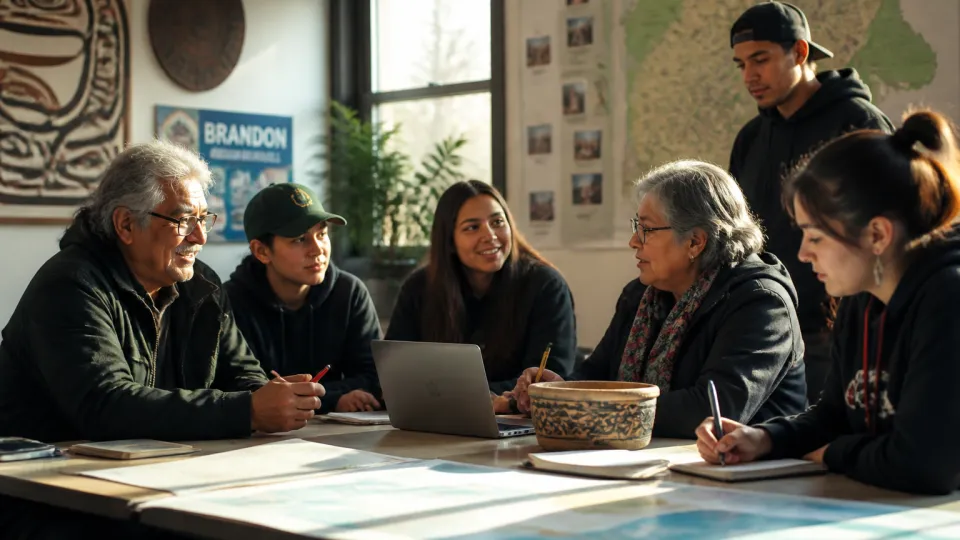
On a cold March morning in Brandon, the light through a school window pools on a table where a dozen hands — teenage and adult — bend over circuits, storyboards and a map stitched with place names in both English and Ojibway. The room belongs to a small learning hub that opened two years ago in partnership with Brandon University and two local school divisions. It is neither strictly K–12 nor a college classroom; it is intentionally in-between, built for people who are returning to school after layoffs, for teenagers who want to try a trade before committing to a diploma, and for elders who want to pass on language and land-based knowledge.
The hub is an example of a quiet but consequential pedagogical shift across Westman. Rather than asking students to fit themselves into existing institutions, educators here are reconfiguring institutions around the varied life paths of a region that still hums with agriculture, small manufacturing and complex cultural histories. The result is an education ecology that privileges flexibility, relationship and local relevance.
"When I first came here from Vietnam, I thought learning would be only textbooks," says Maya, 27, who came to Brandon five years ago and now takes evening digital-skills classes while apprenticing at a local bakery. "What helps is that teachers ask what I need for work and for my life. That makes learning practical." Her comment points to one of the recurring themes across the Westman region: learning that is visibly tied to people’s livelihoods makes schooling meaningful and more likely to stick.
This is not merely pragmatic training for immediate jobs. Partnerships between Brandon University, Assiniboine Community College and regional school divisions are blending academic studies, trades instruction and Indigenous pedagogy. In one pilot program, high school students spend part of their week apprenticing at nearby farms and food processing facilities, and part of their week in classes that include Indigenous ecological knowledge, supply-chain math and planning. Teachers report increased attendance and fewer dropouts. Local employers, for their part, are more likely to hire graduates who already understand the rhythms of regional work and can communicate across generational and cultural lines.
"Education here cannot be siloed," says a teacher who has led experiential-learning courses for nearly a decade. "Our students deserve an education that prepares them for Westman — not just a distant ideal of success." She points to a student who learned welding at the college and now designs equipment modifications for a century-old seed plant outside Brandon. That combination of technical skill, local context and a willingness to take initiative is a new currency in the regional economy.
Another crucial strand is the return of Indigenous voice into mainstream classrooms. Elders and language keepers are being integrated into program design, not tokenized as occasional guests. In one classroom, elders sit with students crafting lesson plans that pair Dakota language lessons with on-the-land activities: identifying medicinal plants, mapping watercourses and recounting local histories. "The goal is mutual literacy," an elder explains. "Young people learn language and land; teachers learn how to teach that knowledge respectfully."
is both a promise and a challenge. Remote learning during the pandemic expanded access for learners in smaller towns, but it also exposed a persistent digital divide. Westman communities have responded with modest, pragmatic solutions: mobile training buses that bring high-speed hotspots and instructors to hamlets; evening labs open in municipal libraries; and a network of volunteer tutors who run hybrid sessions for adult learners juggling multiple jobs.
Such initiatives underscore a central lesson: the best educational interventions in Westman are those that work with, not around, the realities of rural life. They account for unpredictable weather, shiftwork schedules in agriculture and food processing, and the rich interdependence between towns and farms.
The human impact is measurable in small, vivid ways — a former farmhand who completed a business certificate and started a cooperative seed-cleaning venture; a young woman who finished her nursing prerequisites and now coordinates elder-care programs; a classroom that now closes with a unanimous song in Dakota. These stories complicate the usual metrics of educational success. Graduation rates matter, but so do the quieter indicators: sustained engagement, intergenerational exchange and civic participation.
Looking forward, Westman faces choices familiar to many rural regions: how to retain young talent, how to modernize local economies and how to do so without losing what makes the region distinct. Education has become a fulcrum for those choices. If local institutions continue to prioritize place-based curricula, flexible credentialing and deep partnerships with Indigenous communities and employers, the region will be better positioned to adapt.
For now, the learning hub in Brandon hums along, a modest experiment with outsized implications. Around its tables, people of differing ages and backgrounds negotiate what education is for: not merely a ticket to a job, but a way to make a life in a particular place, in conversation with history and with neighbors. "We are learning to learn together," Maya says. "That, more than any certificate, changes everything."
The change is incremental, often improvisational, but it is also durable: built on relationships, local knowledge and a pragmatic sense of what learners need next. In Westman, education is becoming a community project again — one that might offer a model for rural regions beyond Manitoba.