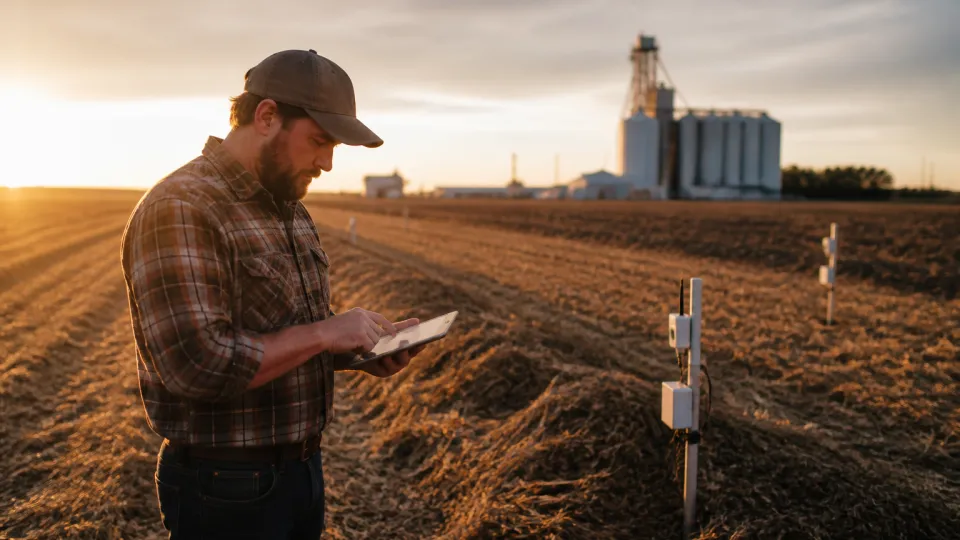
On a cold March morning, long before the combines return to the fields, Emma Korsak walks the perimeter of a quarter section east of Brandon with a tablet in her jacket pocket and a small cylinder of black plastic in her hand. The device, no larger than a soda can, records soil moisture, temperature and electrical conductivity. Where Emma's father used to rely on depth of snow and intuition to judge spring planting, she trusts a constellation of instruments buried in the ground and a cluster of algorithms in the cloud.
'People think of as replacing farmers,' she says, buttoning her jacket against a wind that smells of thaw and old stubble. 'It isn't. It's letting us listen to the land in ways that match what we've always known—just with more detail.'
Emma's farm is one node in an informal network of producers, technicians and students that has begun to reshape agriculture across Westman. Over the past decade, a quiet revolution has taken shape here: sensors and drones have been coupled with regenerative practices, co-operative equipment sharing, and locally tailored software to reduce inputs, improve yields in variable seasons, and strengthen rural economies.
The change did not happen overnight. In the late 2010s, a succession of unseasonable frosts and drought years exposed the vulnerability of monoculture systems heavily dependent on fixed schedules for fertilizer and seeding. Across kitchen tables and over coffee at the farm supply store, farmers started asking two urgent questions: how do we lower risk, and how do we do it without losing the farm to margin pressures?
The first answers were simple and stubbornly local. A group of farmers around Brandon began planting cover crops on small strips of land and measuring how the soil responded. A retired mechanic converted an old grain truck into a mobile workshop for precision nozzles and spreaders. A graduate student at the local college developed an open-source dashboard that translated sensor data into actionable advice for seeding rates and fertilizer placement. By pooling costs and sharing knowledge, the community lowered barriers to tools that individually would have been unaffordable.
At the field level, the impact is tangible. Where compacted soil once choked yields, farmers report softer earth and better infiltration after introducing cover-crop rotations and reduced tillage calibrated by soil sensor feedback. Variable-rate technology applied according to real-time maps has cut fertilizer use by as much as 20 percent on some farms, reducing input costs and runoff risks. In a year of volatile rainfall, those margins have meant the difference between breaking even and staying solvent.
'Last summer, when the rain hit in odd patterns, the sensor maps let us shift seeding rates on the fly,' says Solange Meier, who runs a mixed grain and cattle operation near Rivers. 'We didn't have to gamble based on a calendar. We were reacting to what the field told us.'
Beyond agronomy, these tools have social consequences. Young people who left for university have returned, drawn by work that blends hands-on land stewardship with coding, equipment maintenance and data interpretation. Local shops now offer workshops on drone licensing and soil biology. The weekly farmers' co-op meeting, once dominated by grain prices, now includes presentations by student interns and soil scientists. People speak, now, of a regional identity that includes both heritage and high-tech craft.
There are, of course, limits and trade-offs. Upfront costs remain a barrier for some older farmers, and the volume of data raises questions about privacy and control. A handful of farmers report initial confusion about interpreting complex dashboards or frustration with technology that fails in bitter winters. Community organizers have had to work to ensure that access is equitable and that decisions remain in farmers' hands rather than being ceded to distant agribusiness platforms.
Policy and partnership play a role. Municipal investment in rural broadband and small grants for demonstration plots accelerated adoption. Partnerships between community colleges, local co-ops and farmers created training pipelines. Yet the movement's momentum owes as much to the social architecture—the willingness to share, to host each other's students, to let an experimental strip of land act as a public lab—as to any single gadget.
Looking forward, the innovations in Westman are not an end in themselves but a posture. Climate models for the Prairies are uncertain in detail but clear in trend: greater variability, more intense rainfall events, and hotter summers. The practices taking root around Brandon are designed not merely to eke out a few more bushels but to make landscapes resilient to surprise. Regenerative practices rebuild organic matter; sensors make management adaptive; cooperatives spread cost and risk.
When Emma walks back to the yard, she stops to watch a group of teenagers in coveralls calibrating a sprayer, a tablet between them. Their instructor, a woman who returned from a research post in Winnipeg, points to a map on her screen and asks them what the data promises and what it obscures.
'We're not pretending we've solved farming,' Emma says. 'We're just learning to ask better questions.'
That willingness to learn together—not a sudden obsession with tools but a deliberate, communal experiment—is the story unfolding in Westman. It is local, pragmatic, and human: a patchwork of farms sharing machinery and metrics, grandchildren chasing sheep in demonstration pastures, and neighbors trading soil cores like heirlooms. If the future of Prairie agriculture depends on adaptability more than on any single , then this corner of Manitoba is already practicing the art of staying in the land for the long haul.