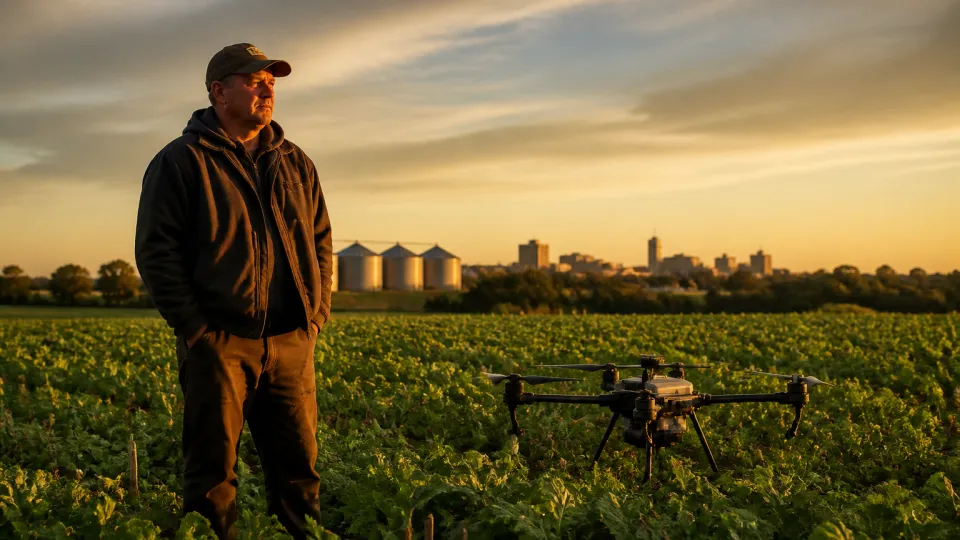
On a cool May morning just outside Brandon, the light falls in long bands over a field that does not look like a battleground. Where only five years earlier the soil had been dust-bare within weeks of seeding, a green carpet of cereal rye and clover ripples under the wind. Lena Rudzinski, a fourth-generation farmer, walks a narrow strip between the rows with the practiced, conversational cadence of someone who knows what the land remembers.
"We used to listen for weather and pray for rain," she says, pausing to run her hand over the rye. "Now we listen to the soil."
"Listening" here is as much literal as it is figurative. The Rudzinski farm pairs handheld penetrometers and moisture probes with high-resolution drone maps and variable-rate controllers installed on a 20-year-old planter. It is a modest constellation of tools—sensors mostly, not flashy robotics—but the combination of old habits and new data has changed how they plant, fertilize and, crucially, whether the next generation wants to stay.
The story in Westman is not a single leap but a series of small, cumulative decisions shared at suppers, school halls and college workshops. Across the region, Assiniboine Community College and the federal Brandon Research Centre have become informal hubs: students intern on farms, researchers pilot cover-crop trials, and farmers swap notes on nitrogen timing. The process is quiet and peer-driven. "If your neighbour is doing it and you can see the difference on their farm, you’re more likely to try it yourself," says Dr. Aaron Chen, a soil scientist who has worked with local growers for a decade.
One practical is interseeding cover crops into standing canola and wheat. The technique reduces erosion and keeps roots in the ground through shoulder seasons. At the Rudzinski fields, interseeding was adopted after a dry 2019 season that left thin topsoil and thinner patience. "We thought about selling," Lena admits. "Then my son came home and said, ‘Let’s try something different first.’"
The son, Tomas, returned after years in Winnipeg tech and helped the family integrate precision mapping and machine-learning software they could afford and adapt. Instead of buying an entirely new combine, they began by outfitting existing equipment with sensors that adjust seed and fertilizer application based on soil variability. "We cut fertilizer use on uneven areas by about 15 percent in year one," Tomas says. "It’s good for the soil and the bottom line."
Savings translate into stability here. When commodity prices wobble, smaller margins can push a farm family to sell. But several Westman growers who have adopted regenerative practices report steadier yields across variable seasons. That gives them leverage: the option to participate in emerging carbon credit markets, to invest in diversified livestock, or to lease land affordably to new farmers. In Brandon and nearby towns such as Carberry and Rivers, these choices ripple through small businesses, grain elevators and the hardware store.
Importantly, the innovations are social as much as technical. A grassroots cooperative—formed last year by a group of growers, agronomists and college students—coordinates shared equipment and lab time for soil testing. "Testing used to be expensive and slow. Now we pool resources," says Maya Singh, who manages the co-op’s outreach. The co-op also hosted a winter forum where a dozen farmers presented case studies: a farmer who reduced diesel use by changing tillage practices; another who doubled on-farm forage diversity to support cattle through drought.
Skepticism remains. Some farmers see precision agriculture as a costly fad. Others worry that new practices demand a level of data literacy and input management that rural communities are still building. But the human scenes remain persuasive—neighbors helping neighbors calibrate a controller late into the night, instructors from the college setting up a field day in a snowstorm, and a younger generation returning because farming looks like a viable, rewarding profession again.
Policy matters, too. Access to small-scale loans, incentives for soil carbon projects, and investments in rural broadband determine how quickly a farm can adopt sensor networks and real-time analytics. Local leaders in Brandon have begun conversations with provincial representatives about targeted support for community-sized innovation hubs rather than top-down corporate rollouts.
Looking forward, Westman faces familiar uncertainties: weather, markets and demographic shifts. But the region also holds a different kind of resilience now. The work here is less about chasing the latest machine and more about reweaving relationships—between people and soil, between neighbours, and between institutions and place. "We’re learning to be patient with the land again," Lena says, folding her hands and smiling. "That’s the real innovation."
In a province where agriculture has long been a story of scale and mechanization, Westman’s quiet pivot—driven by community, modest tech, and soil-first thinking—offers a different model. It is at once conservative and radical: conservative because it honors accumulated local knowledge; radical because it reorients success from a single harvest to a future that can be shared by the next family to come home.
The fields outside Brandon are, for now, still fields. But if you stand there at dawn and listen, you can hear something new: not a single machine, but a chorus of farmers adjusting practices, swapping data, and rebuilding a common bet on a livable rural life.