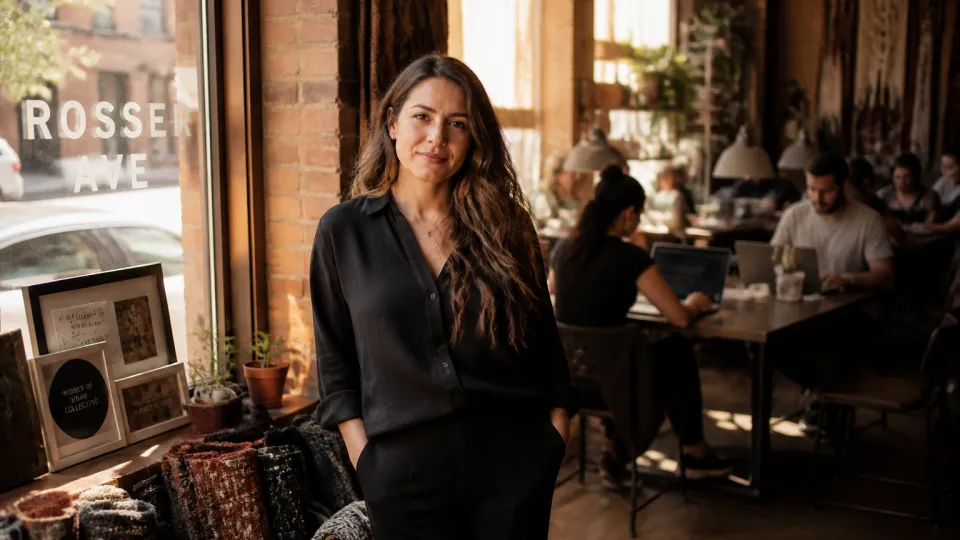
On a late October morning, the marquee on Rosser Avenue reads simply: PRAIRIE LOOM. Inside, sunlight tracks across reclaimed pine floors and long tables where laptops sit beside sewing machines and mason jars of pens. People arrive with different reasons—an immigrant mother learning e‑commerce, a high‑school graduate training in digital fabrication, an older quilter selling online for the first time. They share coffee, a mentor who checks in, and the hum of something being rebuilt.
The founder, Lena O’Hara, is a Brandon native whose résumé looks like a map of outward migration: a degree in sociology, five years in Winnipeg’s tech scene, a short stint in Vancouver with a nonprofit incubator. She came back in 2017 not because she had given up on city life, but because she had started seeing Westman differently. Small towns weren’t just losing talent; they were gaining different assets—cheap space, tight networks, and a yearning to reweave local economies.
"I didn't want to parachute in with a plan," O’Hara says. "I wanted to listen. People here asked for training, a place to sell work, and a safe spot to learn digital skills without leaving home." What began as a pop‑up marketplace in the spring of 2018 became Prairie Loom: a hybrid social enterprise that combines a co‑working hub, a retail storefront for local makers, and a skills program partnering with Assiniboine College and Brandon University.
Prairie Loom’s model is pragmatic. Rent the heritage storefront, offer tiered memberships that subsidize access for low‑income residents, and run cohort programs that teach product photography, online listings, bookkeeping, and simple web design. The retail counter offers rotating stock from twenty‑odd artisans; the co‑work hosts freelancers and a handful of small agri‑tech startups testing sensor designs in a corner lab. The space does not pretend to replace downtown anchors, but it acts as a magnet.
Numbers help make the point. In its first full year it supported 40 artisans, enrolled 120 learners across six cohorts, and created 12 full‑time positions—five of which were people who had returned to Brandon from other provinces. In 2024, Prairie Loom launched "Stitch Forward," a paid apprenticeship focusing on newcomers and youth at risk. The program has a 78 percent placement or further-education rate after six months, according to internal tracking shared with local partners.
Those figures matter because the choreography behind them depends on relationships. O’Hara negotiated subsidized rent with the building’s owners and a small grant with the City of Brandon to fund youth stipends. She convinced a broadband provider to speed a fiber line into the lobby by promising aggregated subscriptions for neighbors. She worked with Westman Immigrant Services to design culturally responsive schedules and with a retired accountant who now volunteers two afternoons a week on book‑keeping clinics.
"What Lena built is not a boutique," says Dr. Priya Menon, a community development researcher at Brandon University. "It's infrastructure—the kind you can map and scale: people, places, and predictable pathways to income. That matters in places where economic life is more brittle."
The human element shows up in small moments. One of Prairie Loom’s earliest trainees, Amir—a Syrian newcomer—arrived with a portfolio of hand‑stitched scarves. He learned product photography in a weekend crash course, set up an online store in a month, and now supplies three local boutiques. "Before I came here, I didn't know how to sell outside the market," he says. "Now customers come from Brandon and beyond. I can save money for my family." Other alumni went on to start food microbusinesses that use Prairie Loom's kitchen during off hours, or to take remote jobs they could have found only after learning digital literacy at the hub.
The space also pulses with contradiction. It is both a respite from and an experiment against the forces driving rural decline: automation, consolidation of services, and the magnetism of big cities. Prairie Loom wrestles with seasonality—summer markets bring cash, but winter months are slow—and with supply chain fragility when artisans rely on material shipments. O’Hara admits there are times when scaling feels like diluting mission. She has resisted venture capital in favor of blended financing—grants, community bonds, and small earned revenue streams.
Looking forward, Prairie Loom is piloting a network model: a toolkit for other towns in Westman to open their own "looms"—smaller, locally governed hubs that share an online marketplace and curriculum. The ambition is not to franchise a brand but to distribute capacity—a way for rural communities to pool expertise and access markets without losing local control. O’Hara imagines a map where each hub knows the artisans and skills of its neighbors, where someone in Neepawa can sell through Brandon’s storefront and vice versa.
"The future of rural isn't about one heroic founder," she says. "It's about building small, redundant systems that let people stay and make a life here on their own terms." That sentence, austere and practical, cuts through the romantic and the promotional. For Brandon, Prairie Loom is not a cure-all but a model: economic work is social work, and the most durable plans are the ones that invest in people.
In a region where leaving has long been the default rite of passage, entrepreneurship like O’Hara’s offers another narrative. It is neither a silver bullet nor a sentimental exercise. It is the patient, measured work of stitching together training, trust, and trade—one seam at a time.