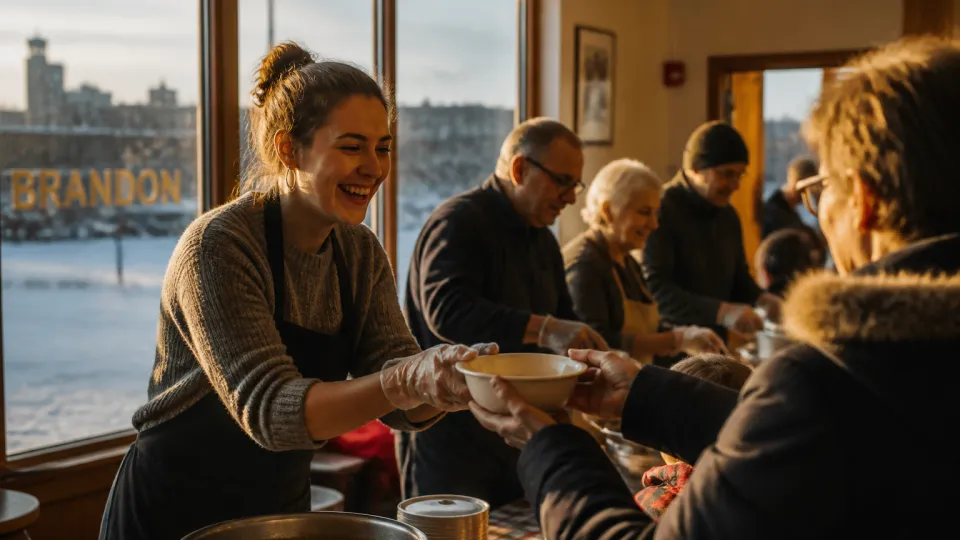
On a late November evening in Brandon, the fluorescent lights of a modest community hall cut a warm rectangle into the cold. Outside, snow crusted the sidewalks; inside, volunteers moved with the economy and familiarity of people who have learned how to turn little windows of time into lasting structures. There was a woman kneading dough, a teenager filling hamper bags with fresh produce, an elderly man who has run the same coffee urn for fifteen years. The room smelled like cinnamon and detergent and a kind of sustained care.
This scene repeats, with variation and improvisation, across Westman: soup kitchens staged in church basements, volunteer drivers ferrying seniors to appointments, high school students tutoring newcomers in math. In a region where municipal budgets are constrained and social needs are both dispersed and concentrated, volunteerism has become a quiet, creative form of public life. Volunteers do more than fill gaps; they produce relationships and local knowledge that formal services often cannot.
Take the example of the weekly community supper that anchors one Brandon neighbourhood. Organized by a rotating coalition of neighbours, faith groups, and university students, the meal began as a response to sudden food insecurity for several local families. It has evolved into something more durable: an accessible space for conversation, a hub for referrals to legal clinics and employment supports, and an informal classroom where English and practical skills are exchanged. 'People come for the meal and stay because they find a network,' said a coordinator who asked to be identified only as Sarah. 'We measure success not just by plates served but by the people who show up again the next week.'
Other initiatives take a more targeted approach. A volunteer-run driving program in rural Westman connects seniors in outlying communities to medical appointments in Brandon, sometimes driving an hour each way. The volunteers often report that what began as a transit service became a lifeline for isolated residents—someone to talk with about a strained marriage or to confirm a memory about where a family heirloom belongs. 'We are delivering more than rides,' said a driver named Mark. 'We are delivering dignity.'
There are also quieter, sometimes invisible forms of labour that knit the region together: volunteers translating intake forms for newcomers, youth volunteers coordinating after-school homework rooms, community members who show up after floods or storms with chainsaws and coffee. One town in Westman now operates a volunteer-led resilience committee that combines weather-watchers, amateur carpenters, and municipal staff to prepare neighbourhoods for extreme events. That committee grew out of conversations at a fundraiser and now has a small budget, formal training, and a roster of people who are willing to go into attics and clear drains when the call comes.
These efforts are not without strain. Volunteers report burnout, an increasing complexity of needs they are asked to meet, and a gap between goodwill and infrastructure. A volunteer coordinator in Brandon described the tension plainly: 'We need funding to train people; we need systems to protect volunteers and clients; we need recognition that this is skilled work.' Many organizations rely on a core cadre of long-term volunteers, and when those people age out or burn out, programs can falter.
Yet in the cracks of strain, is visible. Schools in Brandon have partnered with local businesses to create paid practicum placements that blend education and volunteerism, giving young people both experience and modest compensation. Local coalitions have begun to professionalize volunteer work with peer training, safety protocols, and impact tracking. Digital platforms have made coordination easier, allowing volunteers to sign up for specific shifts and organizations to forecast demand. Importantly, several initiatives are intentionally intergenerational: high school students teach seniors how to use smartphones while seniors pass on woodworking skills to youth.
The human impact of this labour is felt in incremental but profound ways. A single grandmother who receives a weekly meal may avoid a hospital visit; a newcomer who receives tutoring may secure a job; a volunteer driver who listens on a long ride home can prevent a friend from giving up. These are not headlines, but they compound into a different kind of public health: an informal safety net based on relationship, presence, and local accountability.
Looking forward, the region faces decisions about how best to sustain this work. Municipal leaders and service agencies are experimenting with hybrid models: stipends for key volunteer roles, formal partnerships that share liability and training costs, and small grants that allow volunteers to purchase tools and coordinate outreach. There's also a growing recognition that volunteerism cannot replace public investment; it can, however, be a powerful complement if treated as a strategic asset rather than charitable afterthought.
Back in the warm hall, as volunteers closed up for the night, someone flipped the lights off and someone else made a joke that made a tired woman laugh. The routine, the small reparations, the habit of showing up—these are the ordinary acts that accumulate into community. If the region is to remain resilient, it will need to value those acts in practical ways: through training, funding, and policies that recognize volunteer labour as an essential ingredient in the civic infrastructure of Westman. For now, the volunteers keep coming, and the town keeps humming with the low, persistent work of neighbourliness that is, increasingly, the public face of care.