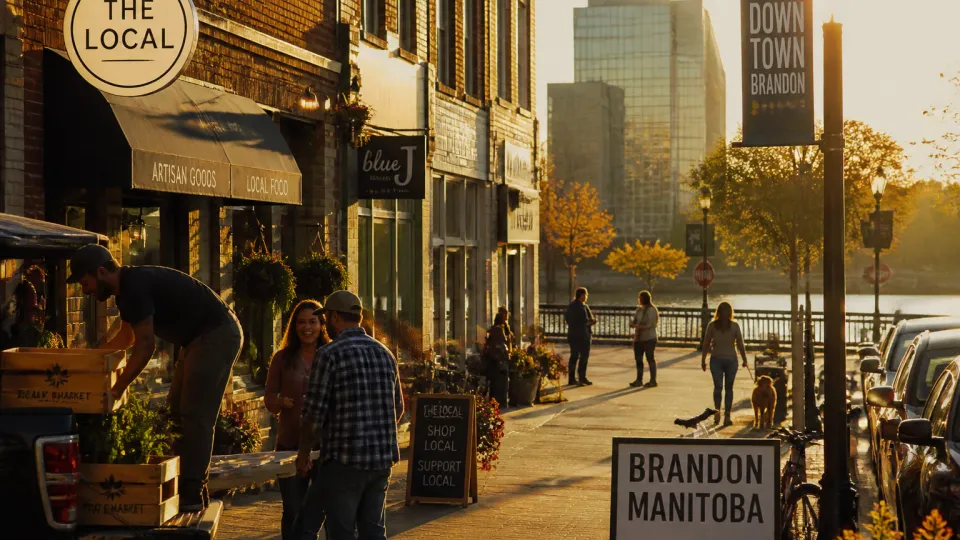
On a cool spring morning, the back door of a modest brick building on Princess Avenue opens before the sun has fully cleared the Assiniboine River. Crates of carrots, jars of pickled beans, and a few battered wooden boxes labeled with hand-scrawled farm names are unloaded and stacked beneath a chalkboard that reads: Prairie Hearth Collective — Shared Commercial Kitchen. The scene could be mistaken for a farmers’ market, except the produce will not merely be sold; it will be transformed, packaged, and shipped across Westman from this single downtown kitchen.
Prairie Hearth opened three years ago when a handful of Brandon entrepreneurs—bakers, small-scale processors, and a group of Indigenous food entrepreneurs—decided the barriers to growth were not demand but infrastructure. Access to licensed space, refrigeration, and regulatory guidance had kept many micro-businesses operating informally. With modest municipal seed funding and volunteer legal clinics from local college students, the Collective created a licensed commercial space that members rent by the hour.
"We used to ferment in my basement," says Maya Sinclair, a pastry chef who pivoted to preserving and heritage grain products. "Having a space where you can scale even a little bit changes the math. I can fulfill a café order without three overnight shifts and I can hire someone from the neighbourhood."
Prairie Hearth is one node in a more diffuse ecosystem of local . Across town, Linden Street Foundry, a metal fabrication studio started by a third-generation machinist, has become a training ground for young tradespeople. The owner, Evan Chartrand, converted an old auto shop into a workshop with a small classroom for apprentices. He partners with Assiniboine College to offer condensed courses in CNC operation and basic welding, and he prioritizes hiring locals who had previously left Brandon or been unable to access formal trades training.
"People want to make things that matter where they live," Chartrand says. "We make gates and railings, yes, but we also make racking for local breweries, repairs for agricultural equipment—things that keep other businesses from closing. There’s a multiplier effect."
This multiplier effect is visible in small, precise ways. Common Thread Studio, a formerly vacant shop on Rosser Avenue, now hosts a textile cooperative where seniors teach traditional quilting and Métis beadwork alongside young designers who sell finished goods online. The studio’s digital platform was developed by a former high-school teacher, Lena Kowalski, who built an e-commerce marketplace that aggregates micro-shipments from around the region so individual sellers avoid shipping costs and complicated paperwork.
These projects share common characteristics: they are place-based, collaborative, and pragmatic. They do not romanticize rural life; they address concrete bottlenecks—capital, training, shared infrastructure, and market access. The leaders are not lone visionaries but networks of people: college students offering pro bono design work, municipal planners who retooled zoning to allow mixed-use production spaces, and older craftspeople willing to teach the next generation.
The impact ripples beyond metrics. Downtown vacancies have declined, not because of marquee investments but because dozens of small leases have been absorbed by start-ups and cooperatives. Young families who might have moved to larger cities to find apprenticeship positions now see places to advance and raise children. Social entrepreneurs working on food security, refugee resettlement, and Indigenous cultural enterprises are using the same infrastructure to create both income and social benefit.
There are obstacles. Scaling remains difficult: regulatory complexity for food processors, rising commercial rents in a compact downtown, and the challenge of accessing patient capital that understands rural seasonality. Several entrepreneurs described the "feast and drought" cycle—periods of intense local demand followed by months when long-distance contracts evaporate. To contend with this, local leaders are experimenting with revenue-smoothing mechanisms: subscription community-supported retail boxes, municipal procurement preferences for regionally made goods, and a nascent microloan fund managed by a coalition of community lenders and a credit union.
What distinguishes Westman’s approach is an emphasis on adaptability rather than replication. Innovation here is not the latest app or an accelerated-growth startup model; it is the steady accretion of capacity—licensed kitchens, maker spaces, training pipelines—that allows many small enterprises to persist and occasionally thrive. The result is an economic texture that resists boom-or-bust cycles by distributing risk across networks.
Looking forward, the question is whether these locally rooted experiments can be sustained and linked across the region. There are early conversations about a Westman logistics hub that would consolidate deliveries from multiple micro-producers and a shared marketing cooperative to reduce duplication of effort. Equally important is policy: municipal zoning that enables mixed-use production, education pathways that value place-based skills, and financing instruments tailored to regional seasonality.
At noon the sun warms the yard behind Prairie Hearth. A student from Assiniboine Community College sweeps the steps while a retiree from a nearby neighbourhood drops off a jar of smoked trout for a community lunch. The work here is not glamorous, nor is it quick. It is iterative and stubborn—small businesses and the community around them quietly inventing new systems of work, care, and craft. In doing so, they are less interested in disruption than in making their place durable, giving people reason to stay and to shape the Westman economy on their own terms.
If innovation in Brandon is measured by the number of apps or venture rounds, these efforts will look modest. But if it is measured by the capacity to sustain livelihoods, train the next generation, and keep culture and production rooted in place, then this quiet retooling of downtowns and backrooms may be the most important kind of innovation of all.