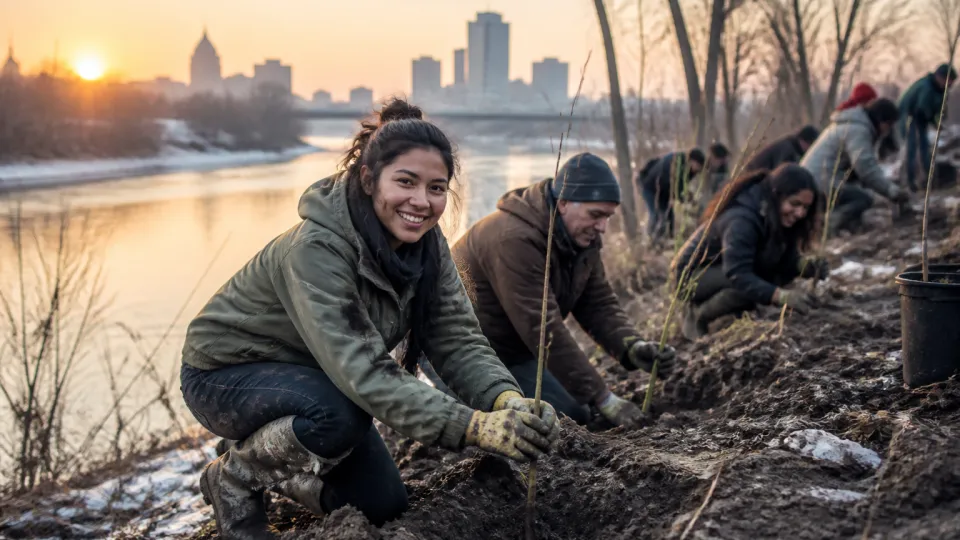
Before dawn, when the city still belonged to the trains and the river, a patch of reclaimed soil on the edge of Brandon smelled of wet earth and coffee. Volunteers arrived with rubber boots and thermoses, greeting each other with the quiet energy of people who had done hard labor together for months. Earl McIntyre, a retired machinist with a gentle laugh and soil under his nails, knelt to tuck a willow cutting into a shallow trench. He had never planned to be an environmentalist, he said, but the place had given him purpose.
The project around him is called the Prairie Roots Initiative, a loose coalition of neighbourhood associations, Brandon University, local Indigenous knowledge keepers, and a small but tenacious team within the City of Brandon. Born from a 2017 community listening process about climate risks and food insecurity, Prairie Roots took shape as a set of practical experiments: riparian restoration on the Assiniboine's banks, edible community gardens on vacant lots, a neighborhood compost exchange, and a youth apprenticeship program that pairs students with elders and researchers.
What began as a scattering of volunteers and sketches on a municipal map has grown into an integrated approach to resilience. The garden plots on the north side produce carrots, beans, and herbs for a weekly market stall run by volunteers; the market is part civic gathering, part food-access program. Downriver, stretches of restored bank now hold willows and native grasses that deflect erosion and cool runoff before it hits the water. Inside a low-slung lab at Brandon University, interns in environmental science map soil health and mentor high-school apprentices who, in turn, teach younger children how to care for worms in compost bins.
'We were tired of waiting for a top-down plan,' says Sonia Patel, the program coordinator who helped knit the partners together. 'So much of what we needed was knowledge, a place to experiment, and permission to fail. This city gave us that.'
Permission to fail has been critical. Early experiments with community composting produced more lessons than fertilizer: contamination, winter logistics, and questions about where the material should go. Learning fast, Prairie Roots shifted to a distributed model. Households signed up for backyard drop-offs; community hub sites hosted processing during warm months. The result is less a single infrastructure and more a networked practice: neighbours exchange food scraps and advice, students gather data, and the city provides space and regulatory flexibility.
The project’s human geometry is what makes it persuasive. Elder Anna Thompson, who has guided land stewardship circles, ties restoration work to stories of place. 'Our people knew how to read the land,' she told a group of apprentices last summer. 'You listen to water, you listen to plants.' Those teachings translated into practical choices — which species to plant on a sloped bank, how to construct a permeable walkway that won’t trap runoff — and also into the everyday rhythms that sustain volunteerism.
Impact is both ecological and social. Restored banks are visibly less ragged after flood seasons, gardens divert food waste and supply produce to families with limited grocery access, and apprentices leave with new résumés and an orientation toward civic problem-solving. Local businesses report modest gains from the market days, and municipal staff speak of the initiative as a laboratory that informed city planning documents and stormwater management pilots.
Equally important is what Prairie Roots has not done: it has resisted becoming a branded program with glossy metrics alone. Instead, the coalition prioritizes adaptability. When a spring flood washed out newly planted saplings, volunteers returned with mulch, work parties, and a revised planting calendar. When funding cycles ebbed, neighbours organized a seed fund and a tool library. These are small acts of durability that add up.
Looking ahead, Prairie Roots faces a familiar challenge: scaling without losing localness. Partners are exploring a regional model to connect Brandon with surrounding municipalities, sharing best practices and a simple handbook for municipal officials. There are conversations about a co-op that could centralize seed saving, nursery propagation, and seasonal staffing. Meanwhile, researchers at Brandon University are refining low-cost monitoring methods so that communities across Westman can track soil moisture, plant survival, and food distribution more consistently.
At the heart of the initiative is an ethic more than a budget line: stewardship grounded in reciprocity. 'We are trying to restore relationships — to land, to each other, and to the future,' Sonia said, watching apprentices measure a newly seeded bank. For Earl, who sweeps the compost pile every Friday, stewardship is quieter: 'It feels good to make something that lasts a bit longer than us.'
If Prairie Roots offers a model for other small cities, it is because it holds both the practical and the poetic: techniques that reduce erosion and produce carrots, alongside stories that teach young people to listen. In a region negotiating changing weather and shifting economies, those two things together may be the most durable resource of all.