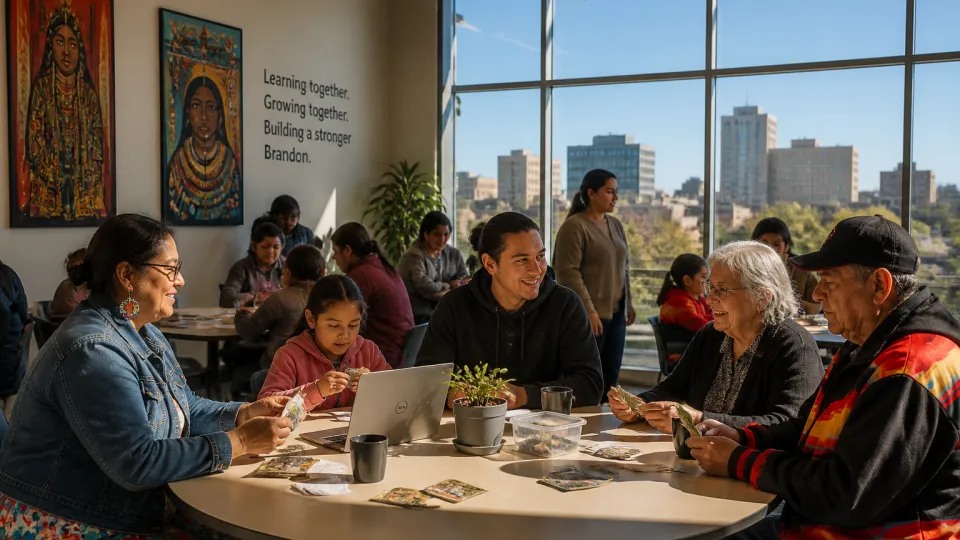
On a cold Thursday evening in Brandon, the fluorescent hum of a repurposed storefront is interrupted by the sound of someone translating the same sentence three ways. At one table, a woman in a bright headscarf points to a sentence in an English workbook; at another, two teenagers lean over a circuit board salvaged from a broken appliance. On the wall, a framed photograph of prairie grass shares space with a hand-painted Métis sash.
This is the Prairie Learning Exchange, a community initiative that has grown in the last five years from a volunteer tutoring program into a hybrid hub for informal and accredited learning. It makes a claim that sounds modest but has been radical in practice here: that learning need not be confined to classrooms or credential factories. It can be stitched into daily life, shared across generations, and anchored to the local economy.
The project began as a response to several unmet needs: adult literacy gaps among newcomers and long-time residents; a drain of youth to larger cities; and the patchy alignment between the skills taught in schools and the jobs available in Westman. The organizers pursued a simple architecture: create a flexible space, invite partners, and let local knowledge set the agenda. Their partners now include Brandon University, Assiniboine Community College, Westman Immigrant Services, and several employers in agriculture and trades.
The impact is most legible in small acts. Alejandra, who arrived from Honduras with two children three years ago, recalls how she felt shut out by signage and forms. 'I wanted to work and to understand,' she says, stirring tea as she describes a Tuesday-night class that mixes language learning with workplace safety training. 'When I learned the words for tools and instructions, I started at a packaging plant. I can help my family now.' Her certificate is not a bureaucratic badge; it is a literal key that opened an evening shift and, with it, steadier pay.
Another piece of the Exchange sits in the former industrial room at the back: a youth makerspace where high-school students repurpose hardware into prototypes for local farms. Jonah, 17, had been drifting between part-time jobs and a guidance counselor's list of options. Through a summer apprenticeship brokered by the Exchange, he learned welding and sensor programming, and now splits his time between school and a paid co-op with a local equipment supplier. 'I used to think learning meant sitting at a desk,' he says. 'Here it means making something the town actually needs.'
Equally notable is how the Exchange has woven Indigenous knowledge into its curriculum without flattening those traditions into token lessons. Elders come in to teach seed-saving and seasonal calendars, to explain land stewardship in relationship to climate change, and to mentor students on the ethics of practice. Mary Sinclair, an Elder who leads a monthly seed-sharing workshop, describes the exchange as mutual: 'Young people bring tools and ideas. We bring stories and time-tested ways. Together we learn how to feed the land and one another.'
The organizers have been deliberate about measurable outcomes—job placements, course completions, and employer satisfaction—but they also track less tangible shifts: people who once avoided public institutions now register for services; parents who lacked confidence in school meetings now sit at the table. The Exchange issues micro-credentials—short, stackable certificates co-designed with employers—so that a learner can convert a weekend of training into recognized skill that rings true at a hiring interview.
Funding has been a patchwork: municipal support, small provincial grants, philanthropic donations, and in-kind contributions from partner institutions. That fragility is also part of the story: sustaining a community-minded model requires steady investment and patient bureaucracies, which are not easy currencies to secure. The Exchange has begun to test social-enterprise models—fee-for-service workshops for small businesses, sliding-scale consulting for regional employers—to reduce dependence on uncertain grants.
What makes the Exchange distinctive is its refusal to treat learning as an individual deficit to be corrected. Instead, it approaches education as a communal infrastructure with social maintenance needs: mentorship, practical spaces, reciprocal relationships with employers, and rituals that transmit local culture. In doing so, it reframes success from an abstract credential tally to concrete things—steady income, community recognition, an elder's blessing on a shared garden.
Looking forward, the Exchange faces familiar dilemmas: scale without dilution, stability without bureaucratization, and honoring Indigenous leadership while growing partnerships. The leaders hope to formalize pathways into post-secondary programs and to deepen employer alliances so that learning maps more directly onto regional job ecosystems. But their more ambitious aim is subtler: to make the town itself a learning organism that adapts as its people do.
If there is a lesson from Brandon's experiment, it is this: education's most durable investments are not always new buildings or high-tech labs, but the low-slung architectures of daily support—people who will teach you to read a contract, to solder a board, to save seeds, and to believe you belong. Those are the gestures that, in the long run, change how a place learns to thrive.