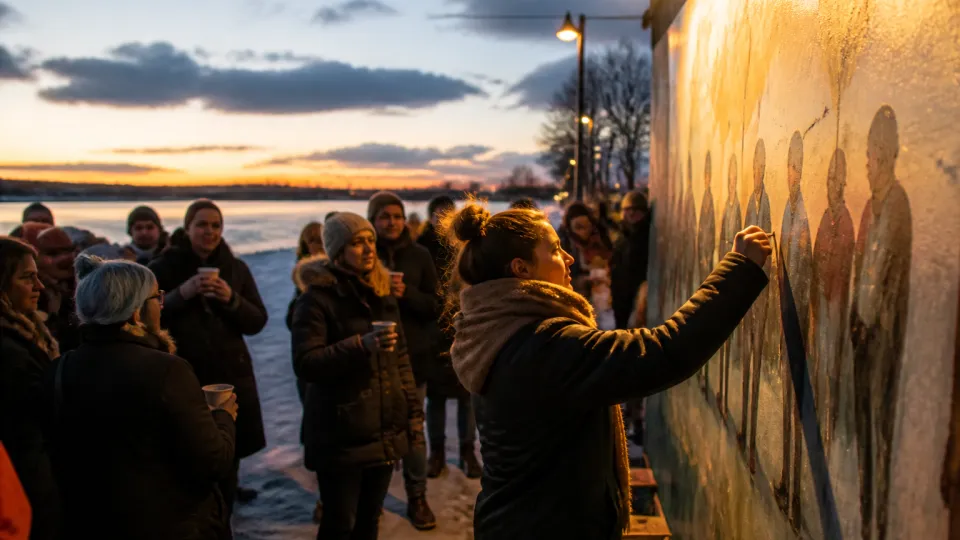
The night the Art Gallery emptied onto the riverbank, it felt less like an ending and more like a handoff. A dozen people lingered beneath sodium lights and a sky that had the stubborn clarity of late spring: artists with paint-stained fingers, a pair of Brandon University students still catching their breath after a set, an older couple who had come to see a friend’s portrait. Inside the gallery, a new exhibition called "Listening Rooms" had wound its way through small galleries and folded, intimate performances. Outside, the town that had funded and tutored and sometimes quietly argued over those artworks was waiting to be spoken to.
That exchange—art as a public conversation rather than a private object—has become the defining project of Brandon’s cultural life in recent years. It’s visible in mural projects painted on laundromats and school façades, in after-school sound workshops for newcomer youth, in a summer of pop-up concerts along the Assiniboine where musicians and buskers take an equal billing. These are not pyrotechnic spectacles; they are incremental stitches in the fabric of a city negotiating change.
Take the mural on 10th Avenue, painted last summer with the help of teenagers from two high schools and a handful of senior volunteers. The wall had been a blank, weathered slab for a generation. Over six evenings, under the direction of visual artist Maya Sinclair, the teenagers learned to translate neighborhood memories into large geometric shapes and color blocks. Sinclair recalls one student who, at the start, could only think of the mural as a task. "By the fourth night he was teaching an elder how to outline a maple leaf," she said. "It became a space where people recognized each other." The finished work asks few literal questions; it functions instead as a ledger of collaboration, readable only if you know where to look.
Collaboration has been purposeful. The Art Gallery of Southwestern Manitoba has expanded its outreach, training volunteers to run tactile tours for visually impaired residents and commissioning small performances that travel to care homes. Meanwhile, the university’s School of Music has partnered with community organizers to reimagine rehearsal rooms as open-lab spaces where students can test improvisational ideas with neighborhood elders. "We aren’t just sending artists out," said Daniel Hodge, director of a local arts collective. "We’re setting up reciprocal relationships. Learning flows both ways."
The consequences are practical as well as cultural. Parents who once hesitated to bring children to gallery openings now show up because the events include brief workshops alongside exhibits. Newcomer families, often left on the margins of civic life, find cultural entry points through bilingual poetry nights and community mural days. Economically, small galleries and performance nights have nudged foot traffic toward nearby cafés and shops on otherwise quiet streets. But the more consequential shift is intangible: a redistribution of civic confidence.
The work is not without strain. Funding remains patchy; many initiatives run on a mixture of municipal micro-grants, private donations and volunteer labor. Organizers speak candidly about burnout. "We celebrate each successful event," a curator told me, "but we’re also always patching the roof while it leaks." Municipal leaders have signaled interest in a more sustained investment—a cultural strategy that would tie arts programming to youth retention and downtown revitalization—but budget cycles and political priorities complicate planning.
Still, there are early signs of institutional change. A proposed arts hub—currently a feasibility study and a stack of community letters—could centralize rehearsal spaces, a storefront gallery, and studios that are affordable for emerging artists. Local businesses are beginning to see culture not as decoration but as infrastructure. Teachers report improved attendance at schools that host after-hours arts programming. These are small data points that, added together, form an argument: creative life can make civic life a little more generative.
Perhaps the most persuasive evidence of impact is personal. At a recent intergenerational workshop, a newcomer teenager who had arrived from Syria brought her sketchbook and, through an interpreter, explained that the act of drawing in public had allowed her to travel the city on her own terms. A lifetime resident, who had retired from a factory job, told a young drummer that his rhythms reminded her of the factory floor, which she had missed more than she expected. These exchanges do not erase structural challenges facing Brandon—economic shifts, demographic transitions, the perennial squeeze on rural services—but they create relational infrastructures that make collective responses possible.
Looking forward, the work in Brandon feels less like a single project and more like a civic discipline: repeated, patient, and open to being remade. If municipal planners and cultural leaders can find ways to stabilize resources—affordable studio rents, predictable program funding, a permanent public rehearsal space—the city’s cultural ecosystem could shift from project-based bursts to sustainable practice. Even now, the art that matters here is the kind that reorders time and attention: slow, insistently human, and often stubbornly local.
On the riverbank, at the end of the gallery night, a guitarist started a quiet blues line and people fell into loose conversation. The work of reimagining public life is not finished; it is, in the best sense, ongoing. It requires more than exhibitions and grant cycles—it asks for time, relationships and the willingness of a city to see its public places as the primary sites of belonging.