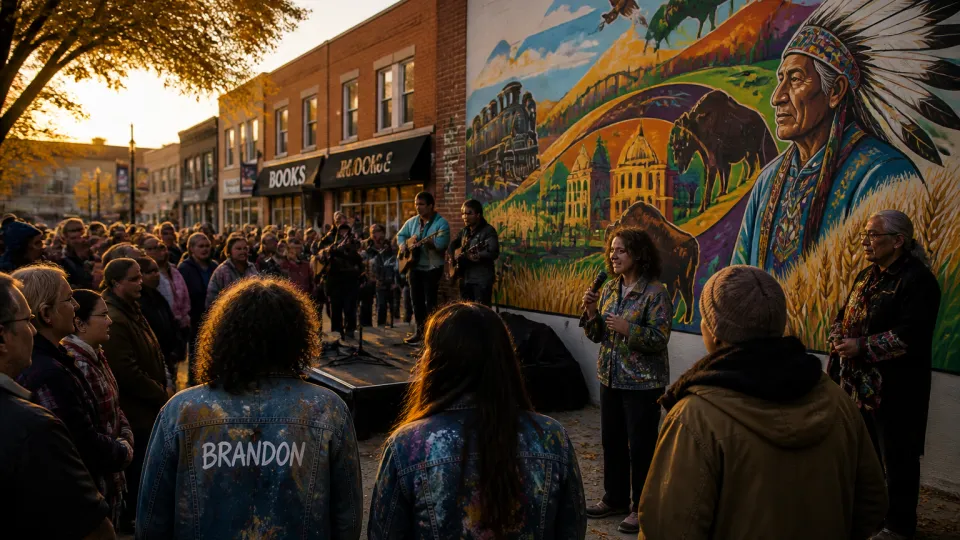
The first time I met Maya Sinclair she was balancing a can of primer and a toddler on her hip, standing in front of a boarded-up storefront that had been a cigar shop for thirty years. The boards were gray and dull; within an hour, with a borrowed ladder and a crate of donated brushes, a curve of cobalt appeared and then a handprint etched into it. Around them, a handful of teenagers from the housing complex next door peeled up posters, put on radios, and began arguing about color. By sundown the street looked like a promise.
Sinclair is the director of the Westman Arts Lab, a two-year-old experiment that has quietly remade several blocks of Brandon into places where people meet and make things together. It started as a response to a municipal call for revitalization and became, against many expectations, a neighborhood project driven by artists, elders, and young people who wanted to reclaim public space for conversation. "We didn't want to parachute art in," Sinclair told me in her studio, where sketches and pay stubs sit side-by-side. "We wanted to build something the town would recognize as its own."
The initiatives are intentionally low-tech: murals painted with grocery-store brushes; weekend pop-up performances in former warehouse lots; after-school printmaking sessions in a school gymnasium. But those modest gestures have had a ripple effect. A mural on a once-vacant block has become a landmark for school buses. A converted storefront gallery has hosted a jewelry-maker who now sells to boutiques in Winnipeg. Weekly music nights started as an attempt to create safe space for teens; they now draw multi-generational crowds and a small but steady cohort of paying attendees.
The project's success, residents say, stems from what it prioritized before paint and playlists: listening. Westman Arts Lab opened channels with local institutions—Brandon University, the Art Gallery of Southwestern Manitoba—and with elders from nearby First Nations. "They asked us what mattered," said Elder Mary Redsky, who helped guide the Lab's Indigenous programming. "They didn't tell us how to grieve or celebrate; they invited us to lead. That made a difference."
That leadership took shape in tangible ways. Redsky led a series of workshops on story-beadwork and song, which became the backbone of a quilt project displayed in the Brandon Farmer's Market. Young participants—several of them not previously connected to cultural programs—said the workshops changed how they saw their neighborhoods. "I used to think art was for other people," one youth participant, Amir, told the group during a late spring unveiling. "Now my name is on a piece of it."
Economically, the Lab's interventions have been quiet but measurable. Small vendors who set up alongside pop-up events report increased weekend traffic; a few artists have sold work for the first time in years. More significant, perhaps, is the social capital being built: parents who used to worry about idle afternoons are now volunteering at workshops; seniors who rarely left their apartments are attending concerts. City council members have started to take note, meeting with the Lab to discuss permanent green spaces and lighting for late-night activities.
Still, the initiative faces familiar constraints. Funding is patchwork—grants, individual donations, and occasional municipal support—and the volunteers who carry programs forward are stretched thin. There are tensions about whose aesthetics get prioritized, and questions about once a novelty wears off. Sinclair is candid about the trade-offs. "We don't want to be a short-term facelift," she said. "Real change takes infrastructure—not just murals but rehearsal spaces, affordable studio rents, and arts education embedded in schools."
The Lab is attempting to move from ephemeral projects to more durable systems. This summer it will pilot a cooperative studio model where local artists rent subsidized bench space and mentor apprentices. It is negotiating with a private landlord to secure a long-term hub in a block that has known better days. And it is documenting participation patterns in partnership with a social-research team at Brandon University to make the case for consistent funding.
What makes the Lab's work compelling is not only its creative scope but its humility. It refuses easy narratives of "revival" and instead measures success in smaller increments: the mother who comes back to a meeting after two years of social isolation; the barista at a nearby cafe who now recognizes the artists by name; the young person who taught their grandmother to use a screen-printed design on a tote. These are the day-to-day transformations that alter how a town understands itself.
In the prairies, where weather and distance can make places feel isolated, such communal practices matter. The Westman Arts Lab is not a panacea, but it is an experiment in reciprocity—an attempt to make culture a shared utility rather than a luxury. As one mural dries into place and a child leaves their handprint in wet paint, the work quietly keeps going, inviting others to show up and, maybe, to stay.
"We hope," Sinclair said near the end of our conversation, "that when the next weathered storefront comes along, someone will see it as an opportunity rather than a problem. That's the legacy I want."