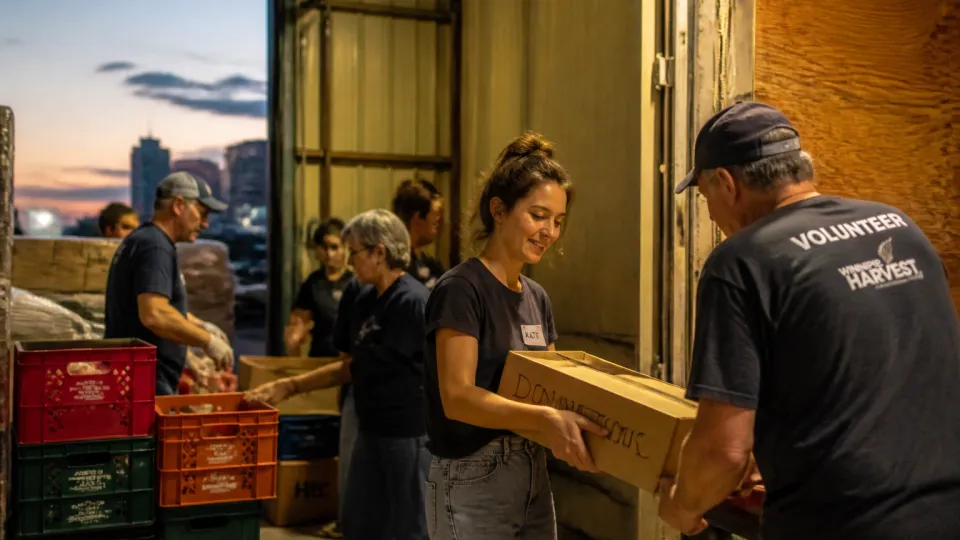
On a cold Tuesday in late March, the warehouse at a downtown Brandon charity hums with the kind of gentle, efficient motion that keeps communities afloat. A retired teacher folds winter coats with practiced hands. Two university students swap stories between pallets. In the back, a man in his sixties unloads a van, then sits down with a cup of coffee and counts the hours he has volunteered this month: “Not nearly as many as before,” he says.
Volunteerism in Westman — and particularly in Brandon — has always been a patchwork: faith groups, service clubs, university cohorts, and long-serving retirees filling gaps between municipal services and people in need. But over the past five years that patchwork has started to fray and re-knit in new patterns. The pandemic exposed long-held vulnerabilities: an aging volunteer base, reliance on a few key players, and ad hoc coordination between groups. What has emerged since is neither collapse nor a return to the old normal, but a quieter, uneven reinvention.
At the heart of the shift are two tensions. First, the demographic reality: many organizations still rely on volunteers who are retired, often in their 60s and 70s. These volunteers bring institutional memory and steadiness, but as they move into their eighties or scale back for health reasons, nonprofits are confronting recruiting shortfalls. Second, younger people conceive of volunteering differently: they favour episodic, skills-based, and digitally mediated engagements over weekly shifts.
“People want impact, clarity, and flexibility,” a volunteer coordinator at a multi-service agency in Brandon told me. “If the role can’t be explained in three lines and scheduled in a couple of clicks, people move on.” Her office last year started posting micro-shifts — two-hour sessions, specific outcomes — and saw an uptick from students and young professionals. But she also cautioned: “Those micro-shifts don’t always build the relationships that keep a food bank running on a monthly basis.”
The result is a two-speed system. Long-term, relationship-driven roles — Meals on Wheels delivery, hospice companions, governance on nonprofit boards — are thinning. Short-term, transactional roles — event day logistics, social-media campaigns, once-off builds — are on the rise. For recipients of services, this is more than an organizational headache. It changes the texture of care. Seniors who relied on the same Meals on Wheels driver for a decade now see rotating faces; community gardens lose the gardener who knew which heirloom tomatoes thrive in Brandon’s prairie winds.
Practical responses have been inventive. Several organizations have pooled resources to create shared volunteer platforms, enabling people to sign up for opportunities across agencies on a single site and earn acknowledgments that transfer between groups. Brandon University and Assiniboine Community College students have partnered with local nonprofits for course credit and work-study placements; these arrangements provide steadier involvement than one-off events. Volunteer Manitoba’s training modules have been embraced locally to professionalize coordination: background checks, role descriptions, and onboarding protocols that reduce friction for new volunteers.
But these adaptations trace uneven lines. Some rural communities in the Westman region — where volunteer culture is both denser and more stretched — report acute shortages, particularly for emergency services and seasonal supports. “We have commitments for winter road clearing and community suppers that are harder to staff,” said a municipal clerk in a neighbouring town. “If the small pool of volunteers burns out, the service disappears.”
The human stories reveal both strain and quiet resilience. A woman I met at a neighbourhood luncheon spoke of taking on extra shifts after her husband fell ill; a young teacher organizes weekend food deliveries around her lesson planning; an Indigenous community leader has convened monthly circles to recruit culturally appropriate volunteers for land-based programming. These accounts show how volunteerism is simultaneously a social glue and a public service — something that nourishes civic ties while filling gaps budget-strapped municipalities cannot.
Looking forward, the leaders I spoke with argued that will come from three interlocking strategies: revaluing volunteer work (through training, recognition, and small stipends), building interoperable systems that let organizations share volunteers and data, and creating pathways for young people that translate episodic engagement into lasting commitment. Municipalities in Westman can play a role by adopting volunteer strategies that include liability supports, digital platforms, and seed funding for coordinator positions that offset the hidden costs of volunteer management.
None of this will replace the quiet generosity of the retiree who shows up every week or the student who packs a food hamper at midnight before an exam. But it can reshape how their labour is supported, scaled, and retained. The story of volunteerism in Brandon is not one of erosion but of reorientation: a community negotiating the ethical and practical work of caring for one another in a time of demographic and cultural change.
As the van pulls away from the warehouse that afternoon, a volunteer glances at a whiteboard where shifts are chalked in neon marker. Names change, priorities shift, but the board remains — a small, bureaucratic testament to the fact that who shows up matters deeply. The question for Westman now is how to make it easier for people to keep showing up, and how to ensure that when they do, their labour is effective, sustained, and respected.