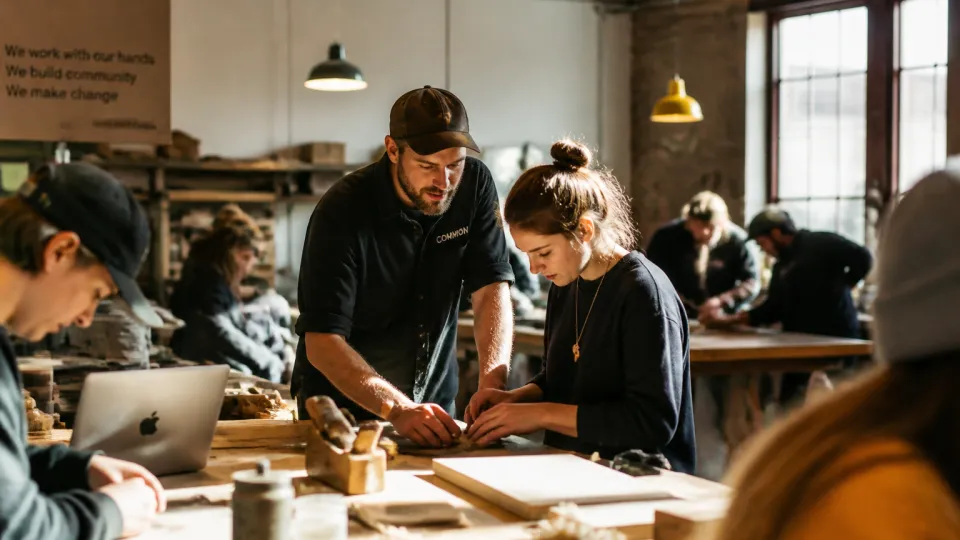
The first light of a prairie morning filters through west-facing windows of a low brick building near Brandon’s industrial edge. Inside, the air tastes faintly of sawdust and coffee. In one corner, a cluster of teenagers huddle over a soldering iron and a circuit board; in another, a woman in her fifties scrolls through an online module about digital literacy. At the center of it all is Emma Levesque, sleeves rolled up, directing a student through the slow business of learning: how to calibrate a sensor, how to troubleshoot when a prototype refuses to work, how to tell a story about what you made so that the farmer down the road might actually use it.
Levesque is a founder of Prairie Learning Lab, a Brandon-based learning hub that has quietly altered the shape of education in Westman. Once a public-school teacher, she left the classroom with a restless set of questions: Why did so many young people—especially in rural towns—feel boxed out of technical and creative education? How could learning be rooted in the local economy rather than in abstract standardized tests? The Lab is her answer, an experiment in what learning could look like when it was responsive to place.
The Lab runs a handful of programs: a maker apprenticeship for high-school students, stacked micro-credentials for adult learners, and short intensives co-designed with local employers in agri-tech and light manufacturing. Those programs don’t imitate classrooms so much as reconfigure them. High-school apprentices earn dual credit through partnerships with Brandon University and Assiniboine College while building practical projects—soil-moisture probes, low-cost greenhouses, accessibility aids for elders—that local businesses and nonprofit groups actually adopt.
"We talk about skills, but what people remember is relevance," Levesque says. "When a student can see a farmer pick up their prototype and say, 'I can use this,' the learning sticks differently. It becomes part of the town’s life, not just their transcript."
One apprentice, a soft-spoken 18-year-old named Liam from Rivers, remembers the winter he almost left school. "I always liked tinkering, but there wasn’t much for me at school. Here I learned CAD, then made a prototype for a feed monitor. A local supplier hired me this summer to build more. That changed everything." His summer job turned into an opportunity to stay in the region rather than chasing uncertain work elsewhere.
The Lab’s model leans on craft and pedagogy in equal measure. Workshops run in small cohorts, with mentors drawn from nearby businesses. A machinist from a local agricultural supplier teaches milling; a software developer runs short courses on data logging and cloud integration. A recurring theme is reciprocity: employers who once complained about workforce readiness now frame the Lab as an active partner in training employees whose skills are aligned with local enterprise.
It has not been easy. Rural broadband limits the kinds of hybrid learning Levesque envisioned; grant cycles are fickle; and as with many community projects, scaling without losing intimacy is a constant tension. When COVID closed in-person activities, the Lab pivoted quickly to home-delivered kits and outdoor, distanced workshops—but the pivot exposed inequities in household internet access that persisted even as people longed for more remote options.
"The crisis showed us both the possibilities and the limits of in education," Levesque says. "We can deliver content online, but we can’t outsource belonging. That’s why our physical space matters."
Beyond measurable outcomes—apprentices who secure employment, adults who retrain for new roles—the Lab’s deeper impact is social. Towns around Brandon report a subtle shift: young people who once left after high school are more likely to return for internships or to start businesses. Parents who remember the one-size-fits-all classroom now see pathways for children who learn differently. Local civic leaders speak of renewed civic pride not as an economic slogan but as a recognition that learning can be the glue of a small-region ecosystem.
Levesque is candid about the limits of any single organization. "We are an experiment in distributed learning," she says. "Policy needs to follow. If provincial and municipal funding recognized place-based micro-credentials and helped sustain partnership staffing, we could do more predictable, long-term work." Her proposals are pragmatic: bridge funding for employer-education partnerships, incentives for rural broadband parity, and a simple registry so local credentials are visible to employers and post-secondary institutions.
Looking forward, Prairie Learning Lab is testing satellite pop-ups in smaller towns, and designing teacher-exchange residencies so schoolteachers can spend a season embedded with local firms. Levesque is deliberate: expansion means preserving mentorship ratios and keeping projects tied to real community needs. This is not about scaling a product; it’s about creating durable nodes of learning that respond to the life of the region.
On a late afternoon when the barn doors are open to a cool wind, a young apprentice lifts a finished circuit and grins. The moment is ordinary and profound: a person who learned to assemble something with their hands and head, contributing to a network where that object matters. For Brandon and the Westman region, the Lab’s quiet experiment suggests a future in which education is less a sequence of credentials and more a civic practice—an apprenticeship in belonging as much as in skill.
"I want people to think of learning as something you do together," Levesque says. "When a community learns, it becomes stronger in ways that show up in jobs, in care, in the stories people tell about their hometowns."